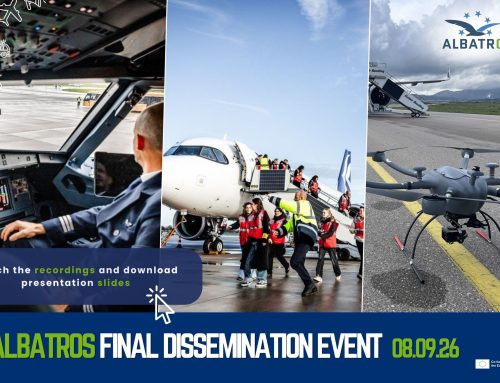


OnDecember 4, 2025, Athens International Airport hosted a critical validation exercise for the ALBATROS project. Moving beyond theoretical models, the consortium gathered alongside airport safety crews and researchers to test the resilience of new safety protocols against the specific operational challenges of hydrogen-powered flight.
The Scenario: Managing Invisible Risks
The drill was built around a precise, high-stakes scenario: a fictitiousAirbus A320neo, powered by hydrogen, requesting an emergency landing due to a fuel system compromise. For the ground teams, the challenge went beyond standard firefighting. Hydrogen flames can be nearly invisible in daylight, and the fuel’s behavior requires a complete revision of standard intervention playbooks.
Operational Response: Tactics and Technology
As the exercise commenced, the focus was on validating two distinct layers of response:
Adapted Firefighter Tactics:Fire brigades deployed using new tactical knowledge. Approach vectors, positioning, and safety perimeters were calculated based on specific H2 flammability characteristics – protocols that ALBATROS has been refining over the past months.
Data-Driven Support:Simultaneously, technical partners piloted a drone equipped with thermal sensors. Instead of just filming, the UAV analyzed the scene, hunting for heat signatures to detect invisible flames. This demonstrated that in future H2 emergencies, real-time data flow to the command center will be as vital as the suppression agents.
The Goal: Proven Replicability
The Athens exercise was not a mere repetition of our previous work in Rotterdam; it was a stress test forreplicability. The objective was to verify if safety protocols developed in Northern Europe remain effective in the specific operational and climatic environment of the Mediterranean. Comparing data from these diverse settings is essential to building arobust, unified European safety standardthat airports can implement confidently, regardless of their location.
A Complex Logistics Achievement
Transforming an active international hub into a testing ground requires exceptional coordination. We thankAthens International Airportfor their operational support andPersie Santamourifor leading the Crisis Planning and execution.
What’s Next: From Validation to Standardization
With the operational phase at Athens complete, the focus now shifts tocomparative data analysis. The technical teams are currently processing the telemetry and operational logs from both Rotterdam and Athens to identify gaps and refine the ALBATROS safety protocols.
These validated insights will directly feed into:
Guidance Materials:Set of recommendations for EU airports handling hydrogen aircraft.
Training Modules:The lessons learned are already shaping the syllabus for the upcoming validation courses scheduled forJanuary 2026, ensuring that future training is based on proven field data rather than theory.
Stay tunedfor the full video report of the exercise and the release of our technical findings in 2026.