

Toolkit
What is the Toolkit?
Guidance & proceduresThis Toolkit is a step-by-step guide to managing ahydrogen leak and fire emergencyon a hydrogen fuel cell aircraft.
It brings togetherinformative cardsthat include visual elements, suggested procedures, communication flows, and guidance on equipment and tools — all in one accessible resource.
The information provided isgeneral in nature, combiningavailable knowledgewithproject-derivedinsights to offer practical guidance where official material is limited. It provides acommon foundationthat can be adapted to local needs and operational contexts.
You can explore the Toolkit in two ways:
- By scenario:follow the sequence of the emergency, from leak detection to post-landing actions.
- By role:focus on the suggested actions for each actor involved.
In both cases, the Toolkit illustrateswhat we suggest should be done, by whom, and when— supporting coordination and decision-making under pressure.
You can also combine both thescenarioand theuser roleviews to better understand how each actor contributes at different stages of the emergency.
Select the scenario:
Select the user:

Leak Detection
This phase marks the initial stage of the emergency, when a hydrogen leak is detected or suspected. The goal is to identify the source of the leak, assess potential hazards, and ensure that first responders are able to react appropriately by being aware of hydrogen’s characteristics. During this phase, the Flight Crew is also shown how the Hydrogen-powered aircraft HMI reacts to the event through warnings, alerts, and system indications enabling them to promptly recognise the threat and initiate the corresponding procedures.
Hydrogen – Behaviour and Hazards
| Feature | GH₂Gaseous Hydrogen – Behavior & Hazards | LH₂Liquid Hydrogen – Behavior & Hazards |
|---|---|---|
| State | Gas under high pressure (350–700 bar) | Cryogenic liquid (–253 °C) |
| Vapour behaviour | Rises quickly, may accumulate in ceilings or compartments | Evaporates into GH₂; dense cold cloud expands and rises |
| Overpressure risk | High if confined or rapidly heated | High – Boil-off may cause tank rupture or BLEVE |
| Cryogenic hazard | None | Frostbite, embrittlement, oxygen condensation |
| Flame characteristics | Invisible, low radiant heat | Same after vaporization (non-luminous, low thermal signature) |
| Flashback / jet fire | Possible with high-pressure leaks | Possible if boil-off is sudden or uncontrolled |
| Explosion potential | Flammable range 4–75%, explosive range 18–59% | Same ranges apply after vaporization |
| Leak detection | Via pressure sensors, acoustic cues, frost on valves | Frosting, condensation, vapor cloud, sensor activation |
H₂ Leak – Hazards and Firefighters Response
- H₂ is odourless, invisible, and diffuses rapidly upward.
- Ignition risk remains high due to ultra-low ignition energy (0.017 mJ). Flammability range 4%–75%.
- Risk of explosive mixture formation in enclosed or partially enclosed areas. Explosion range 18%–59%.
- Upon receiving the emergency call, the Fire Department mobilizes immediately and proceeds to reach the designated touchdown area or estimated arrival point of the aircraft.
- Once on site, they must maintain a safe distance and remain aware of the hot zone (immediate danger area) and the safety zone (buffer for operational coordination and observation).
- Firefighters should use thermal imaging and H₂ detectors to locate any fires, assess the extent of the leak, and identify structural risks.
- Do not attempt to seal the leak unless specifically trained and equipped.
- Ensure no ignition sources are introduced in the area: all equipment used must be ATEX-rated.
- Monitor pressure relief valves and structural deformations near hydrogen tanks for signs of escalation.
H₂ Fire – Hazards and Firefighters Response
- Jet fires from high-pressure releases may extend several meters.
- Hydrogen flame is invisible and emits low radiant heat.
- Jet flame impingement may compromise tank integrity and lead to BLEVE (Boiling Liquid Expanding Vapor Explosion).
- Use Thermal Imaging and H₂ detectors to assess size, spread and risk.
- Shut off hydrogen supply if possible.
- Apply water spray to adjacent structures to prevent secondary ignition.
- Use dry chemical powder only to suppress flame if access to shut-off is blocked.
- Never cool or spray directly onto TPRD (Thermal Pressure Relief Device).
Cockpit HMI Prototype for H₂ Fuel Cell Aircraft – 1

This interface provides an overview of the aircraft’s hydrogen and battery systems. The interface is organised into four main sections:
• In the top-left area, theEngine Statussection shows live data from both engines — including RPM, power output, and temperature.
• In the bottom-left area, theAvailable Powersection displays total and remaining energy from hydrogen and batteries, together with indicative flight time and current consumption.
• In the top-right area, a schematic layout of the aircraft shows the main systems, such as engines, cockpit, cabin, and hydrogen tank.
• In the bottom-right area, the status table lists any detected issues, including the affected system, related actions, and possible limitations.
Along the top of the screen, a navigation bar allows the crew to switch between pages such as STATUS(the current view),POWER CONTROL, BAT & H POWER,SYSTEM CLNG & HT, AIR COND, andBATTERY CHARGING. Each tab focuses on a different part of the hydrogen–electric system, while keeping the same visual structure.
In this scenario, theH TANKindicator is highlighted in yellow and it shows that an elevated hydrogen concentration has been detected in the tank area and alerts the crew that the situation must be monitored closely.
- The highlighted systemH TANKappears in yellow on the schematic.
Cockpit HMI Prototype for H₂ Fuel Cell Aircraft – 2

TheBAT & H POWERpage provides a detailed view of the aircraft’s energy distribution and hydrogen systems. It visualises how electrical power flows from the Batteriesand the Fuel Cell System (FCS)toward the main power distribution unit and, ultimately, the engines.
Each box in the schematic represents a system component — such as BAT 1–4, AUX BAT, FCS, and H TANK— connected by green lines that illustrate the direction and amount of power transferin kilowatts and voltage.
In the lower part of the display, the system reports an increase in hydrogen concentrationnear the H TANK. The yellow value1.0 % volindicates that gas concentration is approaching the safety threshold and should be monitored closely.
At this stage, thestatus tablebelow the schematic shows the H TANKentry with the description HIGH H CONCENTRATION, but no actions are yet required.
Cockpit HMI Prototype for H₂ Fuel Cell Aircraft – 3

This interface shows theBAT & H POWERpage. It focuses on the system’s behaviour once an increase in hydrogen concentration is detected. The interface highlights the affected components and recommends immediate actions.
In the fuel cell area, the hydrogen concentration near the H TANKhas risen to 1.5 % vol, highlighted in yellow to indicate that the value now exceeds the warning threshold and requires crew attention.
The status table listsH TANKwith the description HIGH H CONCENTRATION, clearly marking the critical condition.
UnderAction, the system recommends switching off H TANKand FCS (Fuel Cells)to stop hydrogen feed into the system.
In theLimitationcolumn, the interface advises the crew to LAND ASAP, signalling the need to terminate the flight as soon as it is safely possible.
- Verify that the increasing value nearH TANKcorresponds with the HIGH H CONCENTRATIONalert in the table.
- Execute the suggested shutdown ofH TANKand FCSas per emergency checklist.
- Coordinate with ATC and ground units, prioritising the LAND ASAPlimitation when planning diversion or landing.
Cockpit HMI Prototype for H₂ Fuel Cell Aircraft – 4

This page is theevolution of the previous card. After the increase in hydrogen concentration was detected and the crew shut down H TANKand the fuel cell system (FCS), the BAT & H POWERpage now shows the consequences on available power and flight endurance.
On the right side of the interface, the system displays the actions to performand the current limitationsassociated with the event.
Guidelines on Safety Zone Determination
Initial safety zone:For a hydrogen leak or fire, the initial safety zone is a circle with 200m radius.
The designated hydrogen emergency location should be chosen such that no occupied buildings are within a 200m radius, i.e. the 200m safety zone around the aircraft should not require evacuation of buildings.
Based on additional information on the hydrogen emergency (e.g., information from flight crew, visual or IR camera observations by first responders, etc.) the following changes to the safety zone are recommended:
| Information / situation | Gaseous leak | Gaseous fire | Liquid leak | Liquid fire |
|---|---|---|---|---|
| Situation controlled | Irrelevant | If uncontrolled, increase up to 500m. If controlled, consider other information to possibly reduce. | Irrelevant | If uncontrolled, increase up to 500m. If controlled, consider other information to possibly reduce. |
| Leakage rate / cryogenic cloud size | For small leakage rate reduce radius to minimum 100m. | For small leakage rate reduce radius to minimum 50m. | For small cryogenic cloud use 200m minimum radius from cloud. For larger cryogenic clouds keep up to 500m. | For small cryogenic cloud use 200m minimum radius from cloud. For larger cryogenic clouds keep up to 500m. |
| Wind | Strong winds → reduce upwind to minimum 50m; increase downwind to max 500m. | Strong winds → reduce upwind to minimum 10m; increase downwind. | Strong winds → reduce upwind to minimum 100m; increase downwind to 500m. | Strong winds → increase downwind to 500m. Do not decrease upwind radius. |
| Tank content¹ | For small tank content reduce radius to minimum 100m. | For small tank content reduce radius to minimum 50m. | No impact. | No impact. |
| Ignition sources nearby | If ignition sources are present near the leak, increase safety zone up to 500m. | No impact. | If ignition sources are present near the leak, increase safety zone up to 500m. | No impact. |
Additional note:For a liquid hydrogen leak or fire, monitor surrounding buildings for increased hydrogen concentrations, as hydrogen may travel through ventilation or sewage pipes. If concentration exceeds1.5%, initiate evacuation of affected areas.

In Flight & Emergency Landing
At this stage, the hydrogen leak evolves into an actual threat to flight safety. The Flight Crew, Cabin Crew, and Air Traffic Control work in close coordination to manage the emergency, ensuring passenger safety and preparing for landing. Information flow becomes critical: every action—whether technical, procedural, or communicative. It contributes to maintaining control and reducing risks until the aircraft is on the ground.
Hydrogen – Behaviour and Hazards
| Feature | Hydrogen – Behaviour & Hazards |
|---|---|
| Odourless and non-irritant | Hydrogen has no smell or visual cue; leaks may remain unnoticed until detected by systems or external reports. |
| Rapid upward dispersion | Hydrogen tends to rise quickly; flames or gas may be present near upper sections of the fuselage and doors. |
| Invisible flame | Hydrogen flames are non-luminous and produce little radiant heat → crew may not perceive fire through windows or doors. |
| Risk of re-ignition | Even if fire is temporarily suppressed, it may reignite due to static electricity, hot surfaces or continuing leaks. |
| Vent proximity hazard | Cabin exits located near venting or relief valve zones could be compromised by flames or gas flow. |
| No safe direct firefighting | Standard cabin extinguishers and fire blankets are not effective or safe for hydrogen jet fires or external leaks. |
H₂ Leak – Flight Crew Response Procedures
No immediate action required, but raises pilot awareness. Stay alert, monitor messages, and assess landing options early.
When this level is reached, the crew must follow the emergency procedure below.
- Shut off hydrogen tank and fuel cell.
- Turn on emergency ventilation of hydrogen systems.
- Turn off all non-essential on-board electronics.
- Initiate diversion immediately.
- Monitor energy status and ensure safe arrival with remaining battery capacity.
- Verify “CMPL” message to confirm all required steps completed.
- Coordinate with ATC and prepare for emergency landing.

Prepare for evacuation
- Flight crew informs cabin crew to stand by for evacuation.
- Cabin crew prepares cabin for evacuation.
- Cabin crew instructs passengers to switch off all personal electronic devices.
- Cabin crew informs passengers of evacuation procedures.
Evacuation Procedures and Communication Protocol Flight Crew – Cabin Crew – Passengers
- SCCM
- Senior cabin crew member
- CCM
- Cabin crew member
- 1–4
- Exit position numbers
- L / R / C
- Left, right, centre / overwing exit
- Flight crewinforms cabin crew to stand by for possible evacuation.
- In case of turbulence with suspected injuries, cabin crew identifies affected passengers and informs Flight Crew.
- If injuries are confirmed: number, condition and seat location are reported to Flight Crew.
- SCCM (1L)performs the emergency PA announcement.
| SCCM-1L | CCM-1R | CCM-4L | CCM-4C | |
|---|---|---|---|---|
| 2 | Electrics off (forward galley) | Electrics off (aft galley) | ||
| 3 | Preparation list standby | Preparation list standby | Preparation list standby | Preparation list standby |
| 4 | SCCM briefing. If hydrogen related emergency, notify CCMs. NEW | SCCM briefing. If hydrogen related emergency, CCMs are notified. NEW | SCCM briefing. If hydrogen related emergency, CCMs are notified. NEW | SCCM briefing. If hydrogen related emergency, CCMs are notified. NEW |
| 5 | Lavatory check | Lavatory check | Lavatory check | |
| 6 | Cabin lights on; IFE & PED power off | Class divider open | ||
| 7 | Announcements | Demonstration (forward area) | Demonstration (MCD) | Demonstration (overwing area) |
| 8 | Ladies and gentlemen, may we have your attention. This is an emergency. Keep calm and follow our instructions. | |||
| 9 | All airline staff, police officers, firefighters and military personnel: report to cabin attendants. | |||
| 10 | Set your seatbacks upright. Stow tray tables. Open window blinds. | |||
| 11 | Instruct passengers to: “Turn off all personal electronic devices and refrain from using devices that could spark or generate open flames such as lighters.” NEW Then instruct passengers to remove any sharp and pointed objects such as pens or glasses. Remove dentures and place them in their hand luggage. Stow hand luggage under the seat in front or, if necessary, in the overhead bin. | |||
| 12 | Loosen collars and ties. Remove high-heeled shoes. | |||
| 13 | Sit back in your seat and fasten your seatbelt tightly. | |||
| 14 | The brace position to be taken before landing is explained now. As soon as the command “Brace – brace” is given, place your feet apart firmly on the floor. Place your arms in front of your face and lean forward, resting your head on the seat back in front of you. Remain in this position until the aircraft has come to a complete stop. The brace position for passengers with infants will be explained individually. | |||
| 15 | If hydrogen leakage: This aircraft currently has 2 usable exits in the front of the aircraft. The rear and over-wing exits are not available due to the nature of the emergency. Do not attempt opening them and make your way to the front of the aircraft when instructed to do so. The illuminated strips on the floor will guide you to the exits. NEW If not: This aircraft has 8 exits: 2 at the front, 2 at the rear and 4 overwing window exits. All exits are labelled “EXIT”. Illuminated strips will guide passengers to the exits. | |||
| 16 | Leave the aircraft at the command “Evacuate! Evacuate!” and follow crew instructions. Move away from the aircraft in the direction indicated by the crew. NEW | |||
| 17 | You may read further information in the safety cards located in the seat pocket in front of you. | |||
| 18 | PSP to exit 1L | PSP to exit 1R | PSP to exit 4L | PSP to exit 4R |
| 19 | If hydrogen leakage: Brief passengers seated in overwing window exits not to use the exits. NEW If not: Brief passengers seated in overwing window exits. | If hydrogen leakage: Brief passengers seated in overwing window exits not to use the exits. NEW If not: Brief passengers seated in overwing window exits. | ||
| 20 | Help infants/children/UMs in section 1L | Help infants/children/UMs in section 1R | Help infants/children/UMs in section 4L | Help infants/children in section 4R |
| 21 | Secure loose objects in lavatory | Secure loose objects in lavatory | Secure loose objects in lavatory | Secure loose objects in lavatory |
| 22 | Last cabin check | Last cabin check | Last cabin check | Last cabin check |
| 23 | Cabin secure → SCCM | Cabin secure → SCCM | ||
| 24 | Dim cabin lights if dark | |||
| 25 | Emergency lights on | |||
| 26 | Cabin secure report to the commander | |||
| 27 | 30-second review | 30-second review | 30-second review | 30-second review |
| 28 | Only if crash landing: after the command “Brace – brace”, take position. | Only if crash landing: after the command “Brace – brace”, take position. | Only if crash landing: after the command “Brace – brace”, take position. | Only if crash landing: after the command “Brace – brace”, take position. |
| 29 | After aircraft comes to a complete stop. | Pay attention to commands from cockpit; check hydrogen door indicator before opening the door; advise and instruct pax accordingly. | ||
- Cabin crew opens front doors and initiates passenger evacuation.
- Commands: “Seat belts off”, “Shoes off”, “Leave everything”, “Get out through front exits”.
- Front CCMs call: “Come this way”.
- Rear and overwing CCMs call: “Exit blocked”, “Use front exit”.
- Final cabin and cockpit check → take emergency equipment → exit aircraft.
H₂ Leak – Communication Protocols
COMMUNICATION PROTOCOL — FLIGHT CREW → CABIN CREW
Flight Crew inform Cabin Crew that a hydrogen leak has been detected.
Text: use current phraseology applied to this type of emergency.
COMMUNICATION PROTOCOL — FLIGHT CREW → ATC
In case of ahydrogen leak, the Flight Crew issue a MAYDAYcall instead of thePAN PANcall normally used for kerosene leaks.
The MAYDAY call must communicate the following information:
- Type of aircraft
- Number of people on board
- Fuel remaining
- Estimated time of arrival (ETA)
- Fuel source (hydrogen, electric, etc.)
- Estimated time until critical H₂ concentration is reached
- Dangerous goods on board
- Expected landing site
COMMUNICATION PROTOCOL — CABIN CREW → PASSENGERS
Cabin Crew inform passengers about the situation.
Passengers are instructed to turn off all personal electronic devices and remain calm.
Airport Operations Procedures and Communication Protocol
After being informed by ATC, Airport Operations takes the following actions:
- Declares the emergency — Airport Operations starts the emergency procedure by pressing the “Crash” button.
- This automatically notifies First Responders and core members of the Crisis Management Team(CMT).
- DMO contacts the Airport Fire Department and provides the following details:
- DMO calls the remaining members of the Crisis Management Team (CMT) to assemble.
- Drone Operator is alerted.

Post Landing Operations
Once the aircraft has landed, the focus shifts to on-ground coordination among the Flight Crew, Airport Operations, Air Traffic Control and the Crisis Management Team. This phase involves securing the area, managing evacuation and facilitating the rapid intervention of emergency services.
Crisis Management Team Procedures and Communication Protocol
- Plotter sets up the Crisis Management Room.
- Set up drone stream for Video Output.
- Decide on the scale of the emergency and involve the safety region as needed.
- Coordinate and enable the emergency relief.
- Communicate with the outside world.
- Organise transport of persons on board to shelter locations.
Landing and Taxi Procedures
- ATC vectors the aircraft in for immediate landing.
- ATC clears the airspace around the airport.
- Flight crew closely monitors battery levels to ensure the intended airport can be reached.
- Flight crew follows ATC directions to the runway and makes a safe emergencylanding.
ATC instructs the pilot to taxi to the designated hydrogen location.
1. Location
- Remote:area located away from main airport activities.
- Accessible:easy and quick to reach after landing.
- Upwind position:allows the aircraft to be parked with the nose pointing into the wind.
Suggested location: ends of the runway(s).
2. Ignition prevention
- Grounding facility:equipment available to safely ground the aircraft.
- Concrete base:stable, non-flammable concrete surface under the aircraft.
After Landing Procedures and Communication Protocol Flight Crew–ATC–DMO
- Approximate location of the on-board leak is identified by the pilots.
- Information on the leak location is communicated to ATC(ATC informs DMO, DMO informs others).
- While H₂ is leaking, the H₂ concentration is monitored by the pilots.
- When H₂ exceeds a4% concentration, a call-out is made to indicate that a potentialflammable mixturenow exists within the aircraft.
H₂ Fuel Cell Aircraft – Crash Card
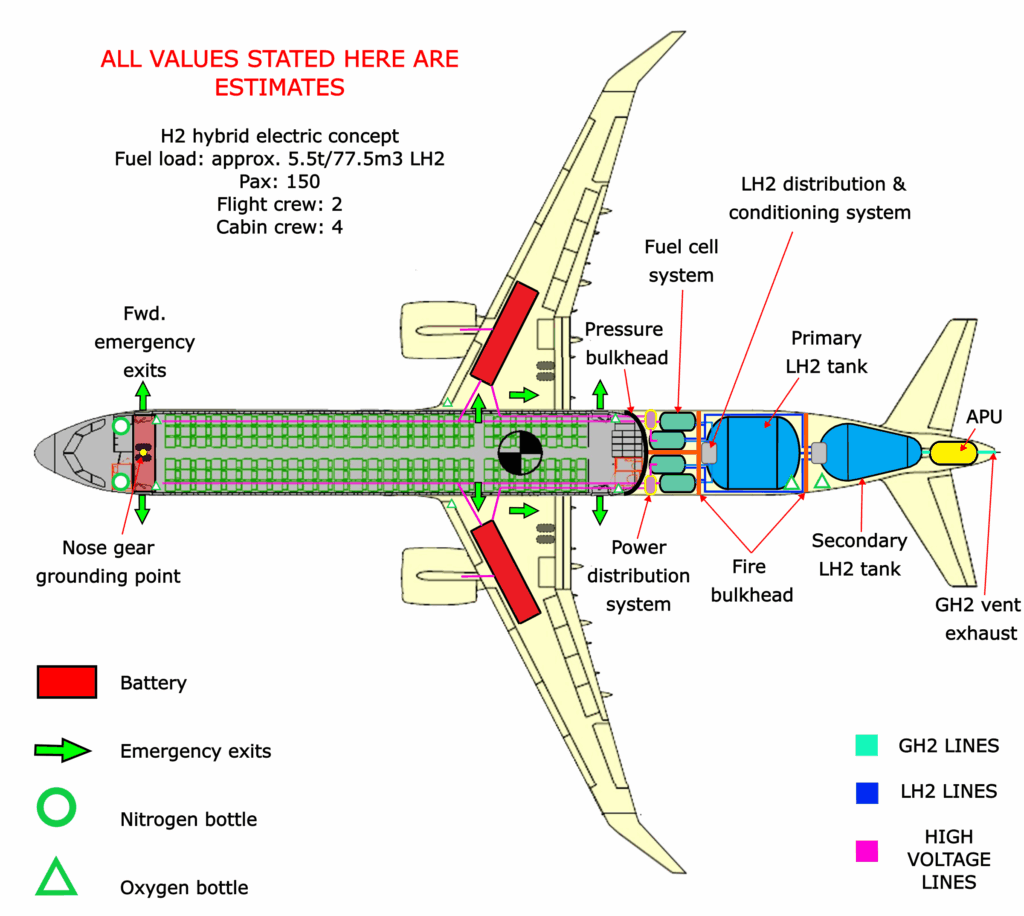
Evacuation Procedures Flight Crew – Cabin Crew – Firefighters
- Flight Crew informs Cabin Crew at exit stations which exits should be unusable considering the wind direction and position of hydrogen leak.
- Cabin crew visually checks if exits are clear and can be used for evacuation and communicates with firefighters about the location of the fire.
- If there is no possibility to wait with evacuation (cabin fills with smoke for example) only the most forward exits should be used to evacuate passengers and crew.
- Any non-usable exits are blocked by cabin crew and passengers are guided towards the usable exits.
Evacuation Procedures and Fire Suppression – Firefighters
- The location of the hydrogen fire is identified by First Responders or Firefighters using Thermal Imaging Systems.
- A safety zone around the aircraft is established by First Responders, where passengers and crew are guided after leaving the aircraft. For more details, see the card in the “Leak Detection”phase:
“Guidelines on Safety Zones Determination”. - Firefighters use water to cool any part of the aircraft affected by the H₂ fire, except for hydrogen vent outlets, which must never be sprayed directly to prevent freezing and blockage.
- Surface temperatures are continuously monitored to confirm they are safe enough to approach the aircraft.
- If any incapacitated passengers cannot be evacuated by the cabin crew, firefighters must enter the aircraft and rescue them.
- Infrared imaging is used to identify any remaining H₂ leaks or fires inside the cabin and to locate any passengers during evacuation.
- After evacuation, the aircraft continues to be cooled by Firefighters until the H₂ fire has completely ceased.
Post Evacuation Operations
Drone remains airborne immediately after evacuation is complete, unless instructed otherwise by ATC or Safety Commander.
Maintain hover position or conduct perimeter scan depending on airspace clearance and fire brigade requests.
Capture high-resolution thermal and optical images of the aircraft, surrounding area, and escape paths.
- Detect residual hot spots, secondary ignition risks, or unseen structural damage.
- Assess hydrogen dispersion based on visible and thermal cues.
- Monitor movement of passengers and first responders in and around the aircraft.
- Support decision-making for re-entry, fire suppression, or area closure.
- Share live video feed with ATC, fire brigade, and DMO through a secured link or designated ground station.
- Log and tag key imagery for post-event analysis and investigation.
- Relocate if the incident escalates (for example, flare-up or explosion risk).
- Assist in environmental monitoring (e.g. gas plume modelling, wind tracking).
- Clearance from ATC or the Incident Commander.
- Confirmation that all hot zones are stable and secure.

Drone Support
The final phase involves the activation of the Drone Unit to support situational awareness and risk assessment. Through aerial monitoring, drones provide real-time imagery and data that help responders evaluate the extent of the hydrogen leak and its potential impact. Information gathered by the Drone Unit is shared across stakeholders to guide safe, coordinated, and informed decision-making throughout the emergency response.
UAS Emergency Response Procedure
- Drone unit is informed about the emergency by Airport Operations.
- Drone unit requests start-up.
- Crisis Management Team sets up the drone video stream for output to the crisis management room.
- Drone video output (payload operational) is visible to payload operator, ATC, CMT, and Fire Department.
- ATC gives clearance to fly, including altitude.
- Drone proceeds to take-off.
- Operator positions the drone upwind of the aircraft.
- Operator maneuvers the drone to identify the hydrogen leak and/or fire.
- Operator tracks the total number of evacuated people (crowd counting).
- Operator shares information with Firefighters and the Crisis Management room.
- Drone remains airborne after evacuation is complete, unless instructed otherwise by ATC or Safety Commander.
- Operator continues to provide decision support to emergency services.
- When the emergency is over, drone operator receives clearance to return to the docking station.
- Operator lands the drone at the designated location after ATC clearance.
Software Requirements for Aerial Image Capture and Analysis
- Modular, cross-platform AI inference engine for real-time computer-vision tasks.
- GPU-accelerated processing capability.
- Compatibility with multiple video sources, including UAS-mounted EO/IR cameras, IP cameras, and other digital video feeds.
- Support for integration of user-developed AI modules or plugins.
- Low-latency real-time processing suitable for time-critical emergency-response workflows.
- High-throughput AI inference to run multiple analytics models concurrently.
- Reliable and secure remote video transmission to emergency response centers.
- GDPR-compliant data handling and secure processing of video and metadata.
- Pre-trained AI models for object detection, tracking, classification, and counting.
- Custom model support for mission-specific algorithms.
- Visualization tools, including overlays and analytics-driven displays.
- Remote operational access, providing live video, analytics viewing, and system control from emergency response centers.
- Configurable event alerts, based on detected objects or predefined operational conditions.
UAS Ground, Airspace, and Operational Control Requirements for Airport EmergencyResponse
- Weather-protected ground station near or on airport grounds.
- Support for charging, diagnostics, and automatic preparation for flight.
- Permanent power and communication link with control center.
- Rapid deployment via secure operator command.
- Clearly mark UAS operating base on aerodrome charts or general maps.
- Ensure crew has a clear understanding of UAS position relative to the airport and surrounding area.
- Ability to fly in flexible, mission-specific airspace zones.
- Clear horizontal and vertical limits for each zone.
- Constant communication with Air Traffic Control.
- Two-way radio contact (VHF/UHF) with ATC.
- Central control station with secure dashboard.
- Live video, maps, system data, and sensor information.
- Real-time updates of obstacles and map data.
- Transfer of drone control between certified operators.
- Encryption and secure storage of communication and mission data.
Unmanned Aircraft System (UAS) for emergency response near airports – Requirements
- Multirotor configurationallowing stable hover and precise maneuverability.
- Integrated sensor payload,including electro-optical (EO) and infrared (IR) sensors.
- Remote IDor equivalent airspace visibility system.
- Satellite positioning (GNSS)and internal sensors (IMU) for precise and safe navigation.
- Onboard obstacle detection and avoidance,including real-time safe-route planning.
- Operational rangesufficient to cover airport grounds and surrounding areas.
- Endurancesuitable to complete emergency response missions without interruption.
- Flight performance flexibility,including fast transit and slow, controlled proximity flight.
- Flight stabilityin moderate or changing wind conditions typical of airports.
- High reliability,ensured through regular maintenance and system health monitoring.
- All-day operational capability,enabling missions both day and night.
- Support for low-visibility operation,using IR sensors when needed.
- Weather tolerance,allowing safe flight in light rain, fog, and moderate winds.
- Fail-safe features,including automated Return-to-Home (RTH) and emergency recovery protocols.