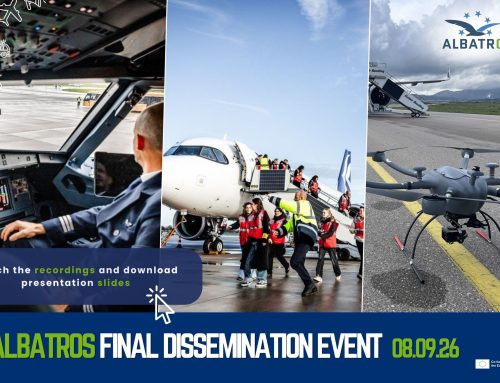

On 25 November 2025, ALBATROS carried out a full-scale emergency simulation at Rotterdam The Hague Airport to validate how airports, first responders, and new technologies should adapt to hydrogen-powered aircraft. This milestone brings Europe one step closer to a safe and climate-compatible aviation system.
Reading time:6 minutes
A milestone for the future of safe, climate-friendly aviation
Aviation is entering a new phase: cleaner energy systems, new propulsion technologies, and new operational risks that the public rarely sees.
On25 November 2025, ALBATROS conducted its majorOperational Validation DayatRotterdam The Hague Airport, a decisive exercise designed to test how future aviation emergencies involving hydrogen aircraft could be safely managed.
The goal was clear:provide real evidence that airports and emergency teams can remain safe and resilient as hydrogen technologies become part of everyday aviation.
This aligns with one of ALBATROS’ core ambitionsto protect passengers, crews, emergency responders, and airport staff as the aviation system transforms.

A realistic emergency scenario—built for real learning
The simulation recreated a high-stakes scenario involving afictive hydrogen-powered A320neooperated by Aegean Airlines:
The aircraft executes asimulated emergency landing.
Airport firefightersrespond using hydrogen-specific procedures.
Athermal-imaging droneprovides real-time data for crisis assessment.
50 volunteer passengers(students from Albeda MBO) are evacuated.
Airport crisis teams activate adapteddecision-support tools and communication channels.
Hydrogen behaves differently from traditional aviation fuel.
This means emergency procedures must evolve—something the general public rarely considers, but which is essential for safe climate transition.This demonstration allowed experts to test and observe these new realities under controlled yet realistic conditions.

A powerful collaborative effort
Delivering this large-scale exercise required remarkable coordination and dedication fromAirport operational teams,Fire brigades and first responders,Researchers and engineers,Crisis management teams,Aircraft manufacturers and technology developers,Training organisations andSafety authorities
A sincere thank you to:
Rotterdam The Hague Airport, NLR – Netherlands Aerospace Centre, Pipistrel Aircraft, Royal Schiphol Group, Athens International Airport, Deep Blue, JAA TO, EASA, and all other partners.
Their work ensures that aviation’s climate transition does not compromise the safety of passengers, crews, and society.

Next: Replicability at Athens International Airport
Next week, the entire exercise will be repeated atAthens International Airport.
This second run will allow ALBATROS to:
Compare procedures between different European airports
Analyse differences in workflows, response times, and coordination
Validate which safety procedures are universal and which must be adapted
Strengthen Europe-wide readiness for hydrogen aviation
This two-location approach is essential to build robust, reliable guidelines for future hydrogen operations.

This activity forms part of the ALBATROSDemonstrations 2, 4, and 14, which you can learn more about on ourAbout page:https://www.albatros-horizon.eu/about/