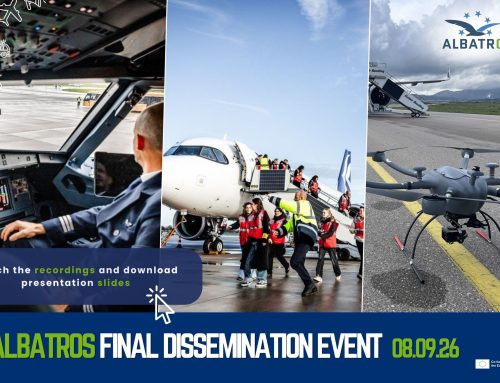


Crisis Planning Supervisor Persi Santamouri breaks down the results of our Athens validation, focusing on how ALBATROS prepares emergency crews for future hydrogen and drone integration.
On December 4, 2025, the ALBATROS consortium gathered atAthens International Airport (AIA)for a critical multi-site validation. The mission was clear: to test how today’s emergency crews can effectively manage the aviation scenarios of tomorrow. As the industry pushes toward ambitious sustainability goals, our work ensures that this transition never compromises operational safety.
The exercise moved beyond theoretical models, adopting an integrated approach that connected advanced technology directly with operational staff. By doing so, we aim to increase survivability and coordination within the complex aviation emergency mechanism.
From the Field: Key Insights from Persi Santamouri
To capture the operational reality of the drill, we sat down withPersi Santamouri, Crisis Planning Supervisor at AIA. In this video interview, she breaks down the challenges faced during the exercise and explains why testing these protocols in a real-world setting is vital for the future of the sector.
The validation pushed the resilience of our staff by introducing specific, emerging threats that go beyond current standard procedures.
Technical Focus Areas
The exercise successfully highlighted three core pillars of future crisis management:
Hydrogen Scenarios:We focused on managing ignition events and leaks, areas where official protocols are still being defined and refined through project-derived data.
Drone Integration:Unmanned Aerial Systems (UAS) were tested as active tactical tools, providing responders with real-time data to optimize their deployment.
Operational Coordination:We streamlined the communication flow between Air Traffic Control (ATC), pilots, and ground crews to ensure clarity under high-pressure conditions.
Watch the full interview below:
Supporting the Response: The Hydrogen Emergency Toolkit
A significant highlight of the Athens validation was the practical application of theHydrogen Emergency Toolkit. This digital resource provided a common foundation for all teams involved, offering step-by-step guidance and role-based actions that were essential for coordinating the hydrogen response scenarios.
You can explore the specific procedures and cards used during the exercise here:
Access the Hydrogen Emergency Toolkit
Looking Ahead to 2026
The Athens validation is just one step in our broader mission. We are continuing our intensive work throughout 2026 to turn these findings into standardized safety frameworks. Stay tuned for further technical developments and our upcoming official reports.
Connect with our work: