

About
Context & Ambitions
Asweather hazardsare becoming more serious and frequent and other hazards are emerging through the gradual introduction ofnew technologiessuch as drones or new fuel and energy aircraft systems, there is a need to reassesscurrent aircraft operating practices and infrastructuresto ensure that the appropriate level ofresilienceexists faced with thesenew threatsto ensure that currentsafetylevels can be continuously improved.
Above all, ALBATROS aimsto improve the resilience of aircraft and airports whilst increasing the survivabilityof passengers, crew and aviation-related workforces such as ground handlers and emergency personnel.
Context & Ambitions
Asweather hazardsare becoming more serious and frequent and other hazards are emerging through the gradual introduction ofnew technologiessuch as drones or new fuel and energy aircraft systems, there is a need to reassesscurrent aircraft operating practices and infrastructuresto ensure that the appropriate level ofresilienceexists faced with thesenew threatsto ensure that currentsafetylevels can be continuously improved. Above all, ALBATROS aimsto improve the resilience of aircraft and airports whilst increasing the survivabilityof passengers, crew and aviation-related workforces such as ground handlers and emergency personnel.

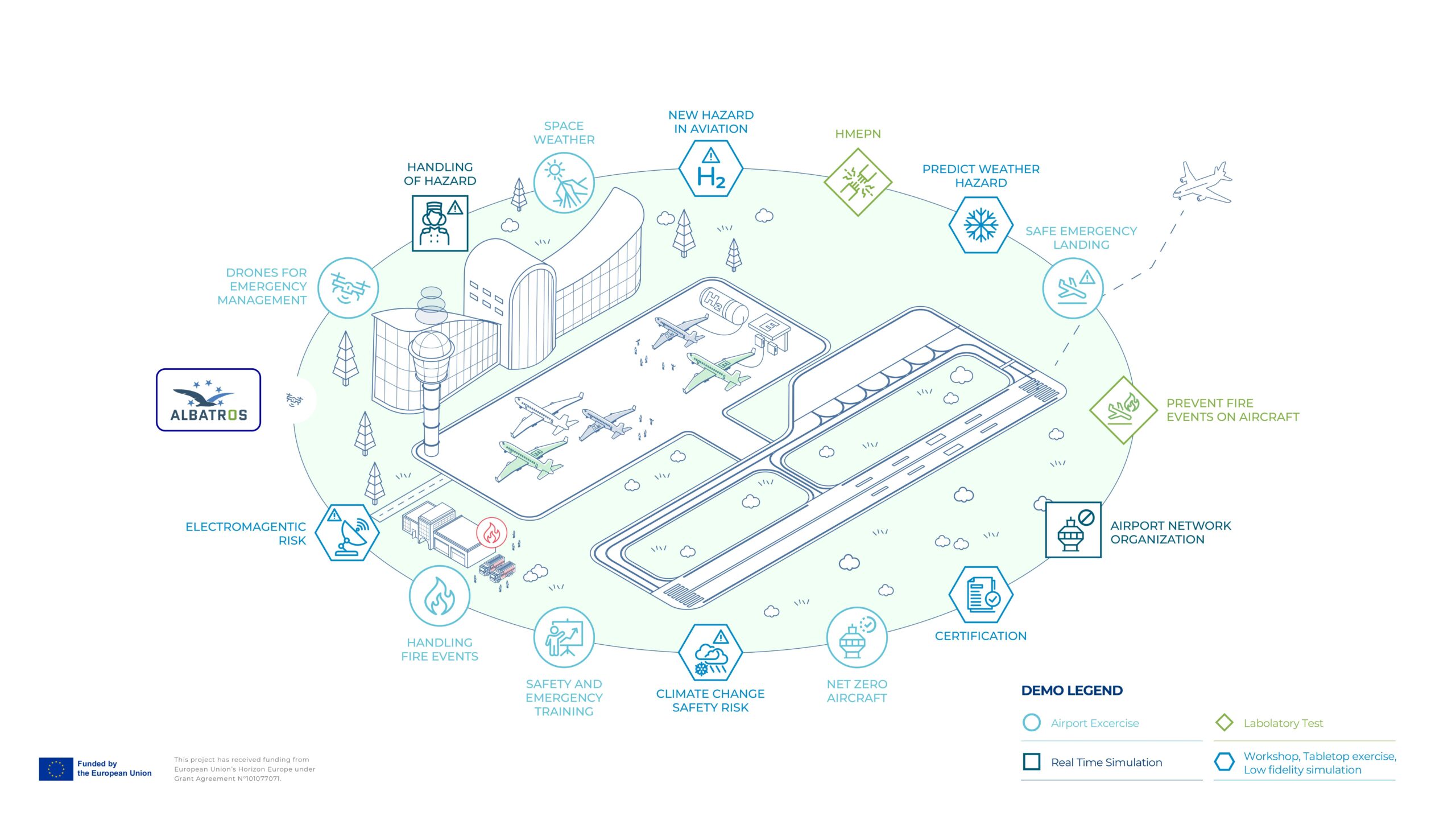
Validating Project Outcomes in real-world environments
 (Demo 1) New Hazards in aviation:
Safety assessment studiesfocusing on new and emerging hazards in aviation, including weather-related events and risks associated with electric-hydrogen powered aircraft and new aircraft entrants.
 (Demo 6) Predict weather hazards:
This activity willaddress extreme weather event scenariosimpacting Europe. Weather forecasting experts and aviation specialists will collaborate to produce realistic services and materials for airport, cockpit, and air traffic management simulations.
 (Demo 11) Certification:
This activity will involve authorities, operational experts, and standards development organizations to share lessons learned from ALBATROS.The goal is to standardizerescue procedures, airport set-ups, operations enhancements, and aircraft design features.
 (Demo 12) Climate change safety risks:
This activity willanalyse and evaluate the applicability of risk matrixto assess the potential impact of climatological change of a meteorological variable on flight safety and flight operations at the airports.
 (Demo 15) Electromagnetic risks:Development and evaluation of asurveillance system to protect against Electromagnetic risks. The demonstration will assess the effectiveness of the EM surveillance system (ZLIF-Air) in detecting electromagnetic abnormal events nearby airport infrastructures dedicated to H2 storage.
 (Demo 3) Handling of Hazards:This simulation will analyze and assess flight crew performance during emergencies involving electric engines and alternate fuel engines. It will also evaluate the effectiveness of the newly developed procedures and HMI.
 (Demo 7) Airport operations in emerging events:The simulation focuses on coordinated airport operations planning during crises and emergencies. It analyzes airport performance, including delays, resource consumption, and recovery time, to optimize crisis response and resilience
 (Demo2 Net zero aircraft evacuation:Prepare first responders to rescue and evacuate occupants from an aircraft with a novel hybrid electric propulsion system. Identify technologies and procedures to mitigate risks for first responders and increase occupant survivability.
 (Demo 4) Safe emergency landing:Validate emergency flight procedures and a digital toolkit for decision support during events involving commercial aircraft with electric propulsion or alternative fuels. Assess the effectiveness of developed emergency protocols and the toolkit’s utility for crisis teams and airport emergency personnel.
 (Demo 8) Cosmic rays and space weather:Space weather and cosmic radiation can impact the performance and reliability of space-borne, ground-based or airborne systems. This activity aims to provide airliners with practical guidance and recommendations to mitigate these hazards in operations and in safety regulations.
 (Demo 10) Handling fire events:Validate and demonstrate concepts, technologies, decision support tools, and best practices for airport emergency staff to handle electric/hydrogen fires.
 (Demo 13) Safety & emergency training:New training courses and material will be developed for emergency response to fires with electric-hydrogen powered aircraft. This activity will serve to assess the first responders’ preparation and reaction, and to validate training modalities, teaching methods, analysis and evaluation methods.
 (Demo 14) Drones for emergency management: This activity aims at assessing the effective utilization of drones with aerial imaging capabilities for managing aircraft incidents and accidents, and support decision making by first responders.
 (Demo 5) HMEPN:Many new aircraft will use electric power for propulsion. This activity will assess the effectiveness of a newly developed health monitoring system (HMEPN) for the electric power network.
 (Demo 9) Prevent fire events:Validate the effectiveness of newly developed Fibre Bragg Grating sensors in detecting hydrogen leakage from fuel tanks and temperatures outside the normal operating range.


















Advisory Board
An international group of stakeholders representingrenowned aviation organizationsadvises the Albatros project. The Advisory Board Members support the project activitiesprovidingdomain specificfeedback. The opinions collected are not intended to represent the views of the organization, but toreflect those of the individual.














Advisory Board
An international group of stakeholders representingrenowned aviation organizationsadvises the Albatros project. The Advisory Board Members support the project activitiesprovidingdomain specificfeedback. The opinions collected are not intended to represent the views of the organization, but toreflect those of the individual.
Latest news

ALBATROS and AEROPLANE: How Europe is Preparing for an Increasingly Extreme Climate
Have you ever wondered what happens when an airport has to shut down because of

ALBATROS Dissemination Event – Save the Date: 12 September 2025
The ALBATROS project, funded under Horizon Europe, is pleased to invite you to its first
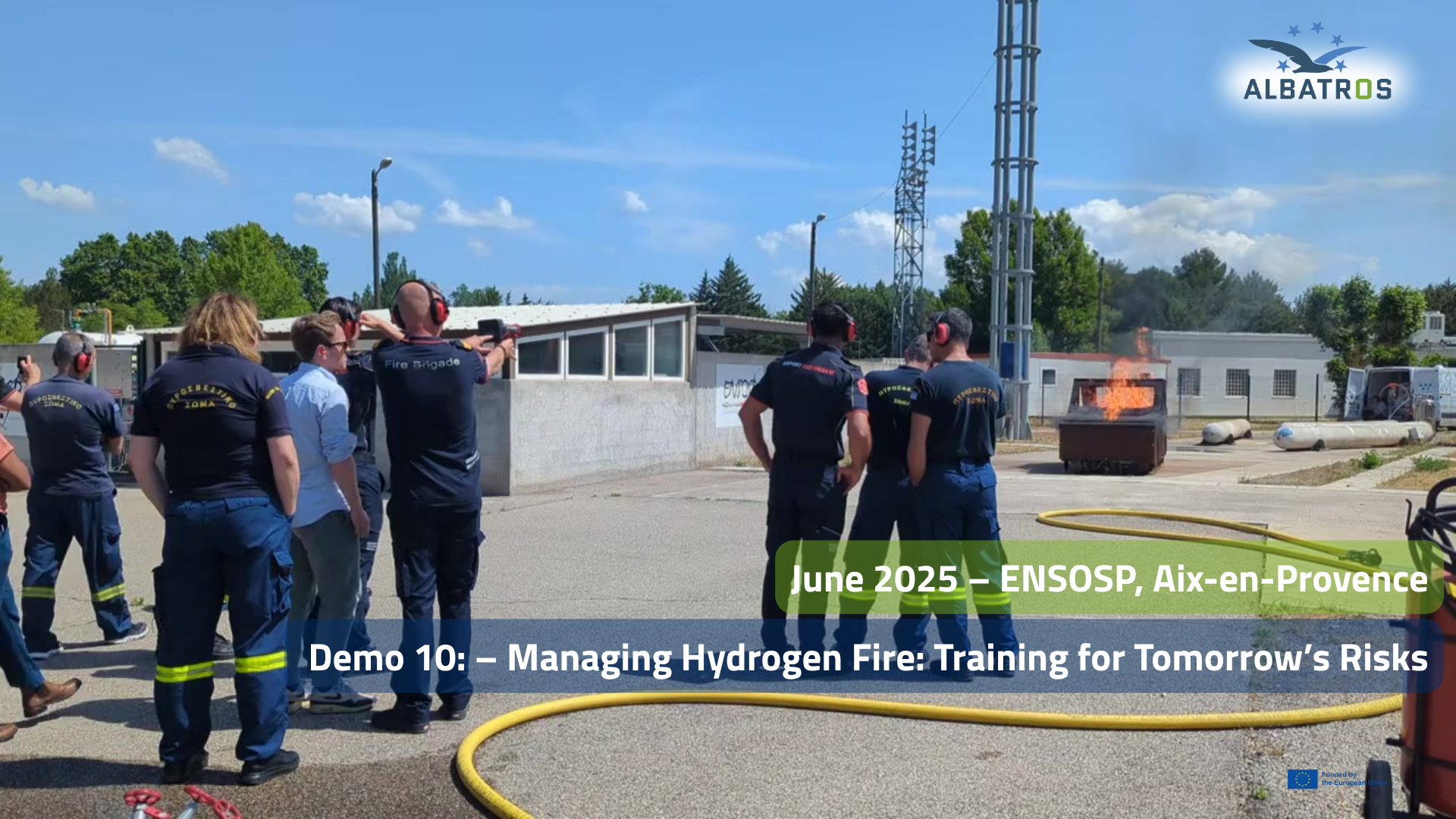
ALBATROS Demo #10: Hands-on Hydrogen Safety Training for Firefighters (Recap Video)
From June 3 to 5, the ALBATROS project conducted an intensive three-day demonstration at
Latest news
ALBATROS and AEROPLANE: How Europe is Preparing for an Increasingly Extreme Climate
Have you ever wondered what happens when an airport has to shut down because of
ALBATROS Dissemination Event – Save the Date: 12 September 2025
The ALBATROS project, funded under Horizon Europe, is pleased to invite you to its first
ALBATROS Demo #10: Hands-on Hydrogen Safety Training for Firefighters (Recap Video)
From June 3 to 5, the ALBATROS project conducted an intensive three-day demonstration at