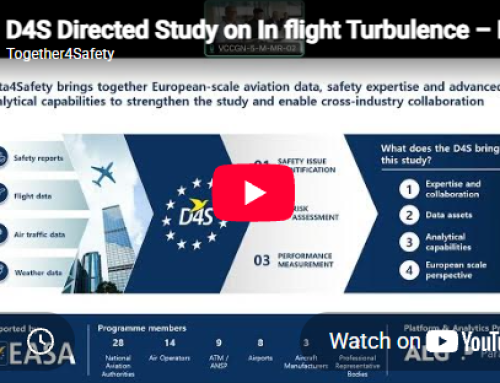

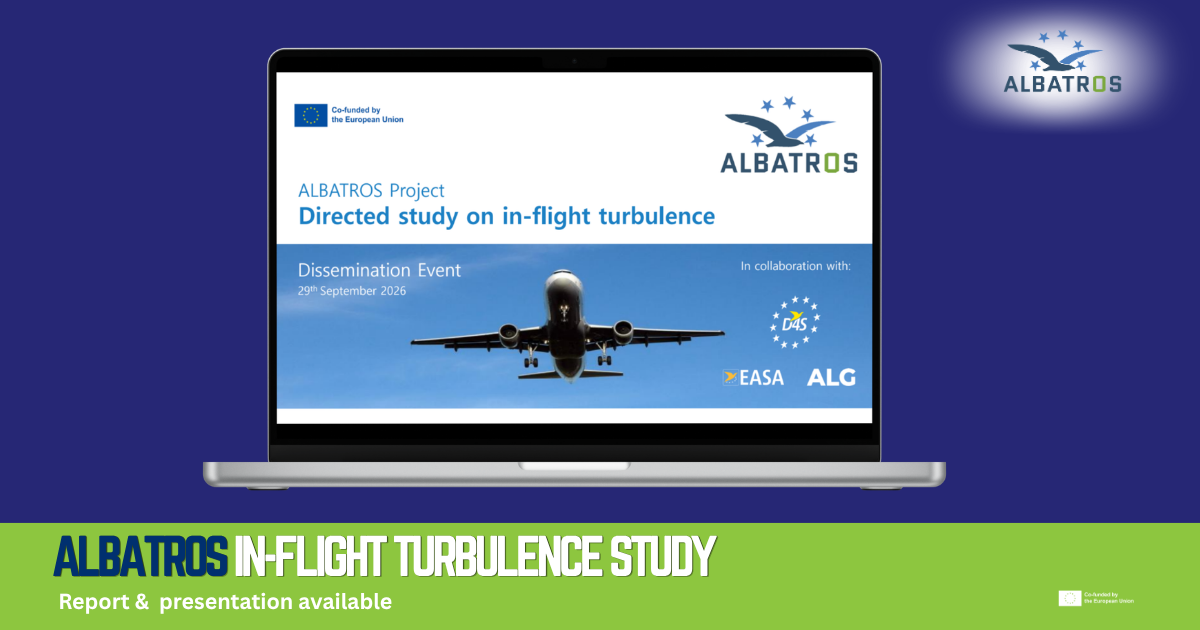
The complete findings of the directed safety study on in-flight turbulence, carried out as Demo 1 of the ALBATROS project in collaboration with the European Union Aviation Safety Agency (EASA) and the Data4Safety (D4S) programme, are now available for download.
This study delivers a quantitative baseline assessment of turbulence risk for European commercial aviation. By combining objective flight parameters from 4.4 million recorded commercial flights (2023–2025) with 22,004 validated safety occurrences from the European Central Repository (2015–2025), the research provides concrete operational findings across three key areas:
Physical exposure vs. reported safety risk: over 70% of physical turbulence encounters occur at lower altitudes during descent and approach, yet nearly half of all reported occurrences take place in cruise, where unexpected clear-air turbulence (CAT) creates the highest potential for operational consequences;
Occupant vulnerability: cabin crew account for more than 67% of reported injuries, predominantly during cabin service, while unrestrained passengers face a 2.5-fold increase in injury likelihood during an encounter;
On-board weather radar technology: newer-generation aircraft with automatic multiscan radar systems eliminate the late-cruise turbulence concentration observed in aircraft using traditional, manually adjusted radar systems.
Download the full documentation directly here:
📄[Albatros Directed Study Turbulence v1.0]
📊[ALBATROS EASA D4S – Dissemination Event In-Flight Turbulence Study_Final 07102026]